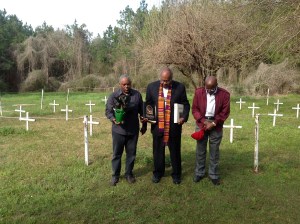
On Friday, May 16, religious leaders met with NAACP representatives and members of the Florida CFO’s office to receive a first-hand report from USF Professors Erin Kimmerle and Antoinette Jackson on their forensic and oral history research into the deaths of boys under state care at the youth facility outside Marianna, FL. In a two hour discussion following the briefing, the group agreed to form the Interfaith Commission for Florida’s Children and Youth and to draft a letter to Governor Scott asking that the disposition or sale of any of the 1400 acres on which the youth facility was situated be put on hold.
While the full scope of the commission will be determined as it takes up this work, the presenting agenda includes: extending due regard and demoralization of the youth whose bodies have been recovered, engaging in community conversations that address how we should remember and care for Florida’s children, and considering recommendations as to the historic preservation of significant structures on the site.
Most of the children who were killed while under state care died before 1957. By then a second school had been opened in Okeechobee. In 1968, the school was desegregated and renamed the Arthur G. Dozier School for Boys. The youth facility was closed in 2011 for financial reasons after extensive publicity around a federal investigation into allegations of abuse.
Within Jackson County there is an economic desire to foreclose research and return at least a portion of the site to development. In particular, there is a state of the art maximum security facility on the site that could become a private youth detention center. The prospect of this happening quickly before all remains of those who have been found have been identified was of deep concern to those at the meeting. There are still many unanswered questions for the final report to address.
Florida’s youth facility was not a rogue institution. Children were sent there from across the state and even from other states. Its history reflects the norm for state practices, from convict leasing and peonage up to private prisons of today. Those shifting norms included racial violence, segregation, and punishments that dehumanize children. Many, if not most, of the deaths of children at the facility were not accidental. The church played a role at the facilities, providing both White and Black ministers on site.
The Interfaith Commission for Florida’s Children and Youth will take seriously how faith was co-opted to support the cultural norms of the day. Our work is not about assigning blame. It is about healing. As we remember the past afresh, may we be inspired to not repeat it in the future. As one state official said, ‘These are Florida’s children. These are our children.” Let us do right by their memory.
We all embrace the well-being of our children. Let us work together so that Florida truly embraces all of its children. For more information and how to join the Commission, contact Rev. Russell Meyer, rmeyer@floridachurches.org
Resources:
 sunshineadvocacy.com